















Blog
14.May.2026
Electrolyte Drink Mixes vs Sports Drinks: What Today’s Hydration Consumer Really Wants
Hydration has become one of the most dynamic categories in functional nutrition. What used to be a simple conversation around “sports drinks” has evolved into a broader market filled with electrolyte drink mixes, sugar-free hydration powders, daily wellness sachets, RTDs, and performance-focused formulations. But as the category expands, consumer confusion grows with it. Many people now ask the same question: what is the difference between an electrolyte drink mix and a sports drink, and which one actually fits their needs?
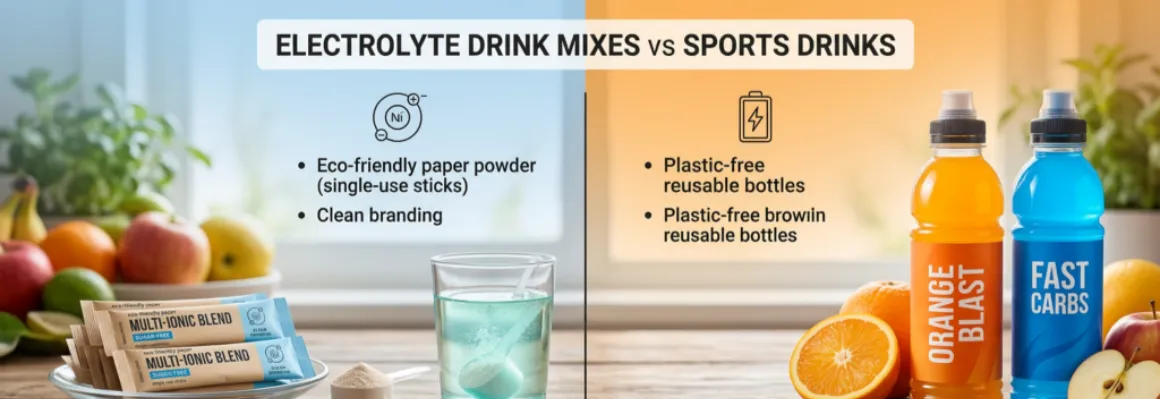
The answer is more nuanced than most product labels suggest.
Not every hydration product is built for the same purpose. Endurance athletes, gym-goers, travelers, office workers, and general wellness consumers all lose fluids differently, consume hydration products differently, and expect different things from taste, sugar, convenience, and performance. A product designed for long-duration sweat loss should not be formulated the same way as a light daily hydration mix for desk workers. Yet in the market, many products blur those distinctions.
This is where smart formulation matters. A well-designed hydration product is not just about adding sodium and calling it effective. It is about understanding the role of sodium, potassium, magnesium, and carbohydrates in fluid balance, energy support, palatability, and product use occasion. It is also about validating whether the formula actually performs well in solution, tastes good enough for repeat use, and fits the consumer’s real routine.
Today’s hydration consumer is more informed than ever, but also more skeptical. They want performance without unnecessary heaviness. They want cleaner labels without sacrificing effectiveness. They want convenient formats, better flavor, and formulas that make sense for how they actually live. That is why the old sports drink model is being challenged by a new generation of electrolyte drink mixes.
Traditional sports drinks were largely designed around athletic activity, especially sweat replacement during or after exercise. Their formula logic was straightforward: provide water, electrolytes, and carbohydrates in a ready-to-drink format that is easy to consume during physical exertion. That model still has value, especially in endurance and prolonged training settings.
But the modern consumer is broader than the traditional sports drink user. Many hydration customers today are not marathon runners or elite athletes. They are office workers who sit in air-conditioned environments all day, busy professionals who forget to drink water, travelers exposed to dry cabins and irregular routines, gym members doing moderate training, or general wellness consumers looking for better hydration habits.
Those users do not all need the same sodium load. They do not all need the same carbohydrate level. And they definitely do not all want the same sweetness or flavor intensity.
That is why electrolyte drink mixes have gained traction. They offer flexibility, portability, customizable dilution, and cleaner positioning for consumers who want hydration support without feeling like they are drinking a traditional sports beverage. At the same time, sports drinks remain relevant where energy delivery and rapid fluid replacement are more critical.
The real formulation question is not which category is superior in theory. It is which category is better designed for the intended use case.
Electrolyte drink mixes are typically designed to support hydration by delivering minerals such as sodium, potassium, and sometimes magnesium, often with low or no sugar. Their appeal lies in portability, convenience, and broader everyday use. They are especially attractive to consumers who want hydration support without the calorie load or sweetness profile of conventional sports drinks.
Sports drinks, on the other hand, are traditionally designed for situations involving more substantial fluid loss and energy expenditure. In addition to electrolytes, they usually contain carbohydrates that help provide fuel during prolonged exercise and may also improve fluid absorption under the right conditions.
That distinction matters because hydration is not only about replacing water. It is also about what the body is losing and what the consumer is trying to accomplish.
If someone is running long distances, training in heat, or sweating heavily over time, a formula with both electrolytes and carbohydrates may be more appropriate. If someone is sitting at a desk, walking between meetings, or looking for a better way to drink water throughout the day, a lower-calorie electrolyte mix may make more sense.
The best products are built around that reality rather than chasing trends blindly.
Sodium plays a key role in fluid balance and is the primary electrolyte lost in sweat in meaningful amounts. That is why sodium is often the backbone of effective hydration products, especially those intended for exercise, heat exposure, or heavy sweating. A hydration formula can include multiple minerals, but if sodium is too low for the intended use, the product may not deliver the performance consumers expect.
That said, not every hydration user needs a high-sodium formula. This is where the category often gets oversimplified. A very high sodium level may be useful for endurance athletes, outdoor workers, or people with intense sweat loss. But for office workers or light daily hydration users, that same formula may taste too salty, feel too intense, or simply be unnecessary.
A smart manufacturer matches sodium level to the use occasion. The formula should answer a practical question: who is this product for, and what kind of fluid loss are they likely trying to address?
This is exactly why electrolyte drink mixes are often segmented more effectively than old-school sports drinks. They can be designed for different hydration moments instead of assuming every consumer is training like an athlete.
Potassium helps support electrolyte balance and contributes to the broader hydration story, which is why consumers often expect to see it on labels. Magnesium is also popular because it aligns with active lifestyle and recovery positioning. Together, they help create a more complete mineral profile and can strengthen the product’s perceived value.
However, these minerals should not be treated as decorative label ingredients. They influence both formulation and consumer experience. Certain mineral forms can affect taste, solubility, and overall mouthfeel. Some may introduce bitterness or metallic notes. Others may be less compatible with a clean, refreshing flavor profile unless the system is balanced carefully.
The most effective hydration products do not just add magnesium and potassium for marketing appeal. They integrate them in forms and levels that make sense for taste, stability, and intended function.
This is where OEM expertise becomes especially important. A hydration formula may look impressive in a specification sheet, but if the mineral system creates harsh flavor, poor dissolution, or an unpleasant aftertaste, the product will struggle in the real market. Repeat purchase depends as much on drinkability as it does on nutrition logic.
But in hydration science and product design, sugar-free is not automatically superior.
Carbohydrates play an important role in many sports drinks because they help provide energy during prolonged exercise and can support fluid absorption when formulated appropriately. For endurance athletes, cyclists, runners, or people engaged in extended physical activity, removing carbohydrates entirely may actually reduce the product’s usefulness.
This is where many hydration brands oversimplify the message. They position sugar-free as universally cleaner and better, even though the ideal carbohydrate level depends heavily on the consumer and use case.
For office workers, travelers, light gym users, or general wellness consumers, a sugar-free electrolyte drink mix may be exactly the right solution. It can encourage fluid intake without excess calories and fit seamlessly into a daily routine. But for intense training or long-duration sports, some carbohydrate inclusion often makes more formulation sense than a zero-sugar approach.
The better question is not whether sugar is good or bad. It is whether the carbohydrate level matches the product’s actual job.
A strong hydration portfolio recognizes this and does not force all consumers into one nutritional philosophy.

For this group, the hydration product must perform, not just market well. If the drink is too sweet, too flat, too salty, or too heavy, the user may reduce intake, which defeats the purpose. That is why lab validation and sensory balancing matter so much.
The biggest challenge here is not extreme performance. It is making the formula pleasant enough for consistent daily use. Overly salty profiles, excessive sweetness, or overly aggressive flavoring can all reduce compliance.
This split is one of the most important truths in the hydration market: the best product for an athlete is not always the best product for the average consumer. Brands that understand this create better segmentation, stronger positioning, and higher repeat purchase.
A powder can have a great formula on paper, but if the flavor gets tiring halfway through a bottle, the product fails in practice. This is especially true in electrolyte systems, where sodium, magnesium, potassium, acidulants, sweeteners, and flavor compounds all compete in the sensory profile.
Saltiness needs to feel refreshing, not briny. Sweetness needs to feel clean, not syrupy. Acidity needs to lift the profile without becoming harsh. Mineral bitterness has to be managed carefully. And all of this has to hold together across different dilution behaviors because consumers do not always mix products exactly as directed.
That is why hydration flavor development is more technical than many people assume. It is not only about choosing a good fruit flavor. It is about designing a flavor system that works with mineral chemistry, target use occasion, and consumer preference.
In practice, this often means extensive bench testing, dilution trials, and iterative sensory adjustment. A hydration drink must be functional, but it also needs to invite another sip.
Osmolality refers to the concentration of dissolved particles in a solution, and it influences how a hydration product behaves in the body and how well it fits its intended use. In simple terms, it helps determine whether a beverage is too concentrated, too light, or balanced appropriately for fluid delivery and product experience.
In the lab, validating osmolality helps formulators understand whether the combination of electrolytes, carbohydrates, acids, sweeteners, and other dissolved components is working as intended. It is one of the key checkpoints that separates thoughtful hydration design from guesswork.
This becomes especially important when brands try to load products with “more” of everything. More minerals, more actives, more carbohydrates, more positioning claims. The result can be a drink that looks powerful on the label but performs poorly in use because the system becomes too dense, too harsh, or too difficult to drink comfortably.
Good formulation is not about excess. It is about balance.
Hydration products need to be tested for more than nutrient presence. They need to be evaluated for dissolution, flavor stability, pH behavior, mineral compatibility, sweetness profile, and sensory consistency across intended use conditions. If the product is a powder, it should also be assessed for flowability, moisture sensitivity, clumping risk, and how it behaves when mixed by real consumers rather than only in ideal lab conditions.
Flavor validation is just as important as technical validation. A product might pass every specification and still fail if the sensory profile does not hold up. That is why hydration development often includes multiple rounds of flavor work, mineral balancing, sweetness adjustment, and use simulation.
The strongest products are those that survive both chemical testing and human reality.
Athletes want formulas that perform under stress. Office workers want drinkable daily hydration without unnecessary sugar or intensity. Wellness users want convenience and clean labels. All of them want better flavor, clearer positioning, and formulas that feel purposeful rather than inflated.
This is why the category is moving beyond the traditional sports drink model. Consumers no longer want one hydration solution for every scenario. They want smarter segmentation, better usability, and products that fit real routines.
In that environment, electrolyte drink mixes have a major advantage. They are portable, flexible, and easy to tailor to different user needs. But sports drinks still have a critical place when energy support and performance hydration matter more.
The market winner is not the product that screams the loudest about electrolytes. It is the one that understands who it is serving.
Sodium, potassium, magnesium, and carbohydrates all have a role in hydration, but the right balance depends on the context. Endurance athletes need a different hydration strategy than office workers. Sugar-free can be a smart choice, but not always the best one. And a strong hydration product must prove itself not only on paper, but in the lab and in the consumer’s daily experience.
That is what today’s hydration consumer really wants: not more hype, but better formulation.
For brands, that creates a clear opportunity. The next wave of hydration winners will be the ones that combine science, segmentation, flavor expertise, and real-use validation into products people actually want to drink.
The answer is more nuanced than most product labels suggest.
Not every hydration product is built for the same purpose. Endurance athletes, gym-goers, travelers, office workers, and general wellness consumers all lose fluids differently, consume hydration products differently, and expect different things from taste, sugar, convenience, and performance. A product designed for long-duration sweat loss should not be formulated the same way as a light daily hydration mix for desk workers. Yet in the market, many products blur those distinctions.
This is where smart formulation matters. A well-designed hydration product is not just about adding sodium and calling it effective. It is about understanding the role of sodium, potassium, magnesium, and carbohydrates in fluid balance, energy support, palatability, and product use occasion. It is also about validating whether the formula actually performs well in solution, tastes good enough for repeat use, and fits the consumer’s real routine.
Today’s hydration consumer is more informed than ever, but also more skeptical. They want performance without unnecessary heaviness. They want cleaner labels without sacrificing effectiveness. They want convenient formats, better flavor, and formulas that make sense for how they actually live. That is why the old sports drink model is being challenged by a new generation of electrolyte drink mixes.
Why Hydration Products Are No Longer One-Size-Fits-All
The biggest change in the hydration category is not just format innovation. It is the shift in consumer expectations.Traditional sports drinks were largely designed around athletic activity, especially sweat replacement during or after exercise. Their formula logic was straightforward: provide water, electrolytes, and carbohydrates in a ready-to-drink format that is easy to consume during physical exertion. That model still has value, especially in endurance and prolonged training settings.
But the modern consumer is broader than the traditional sports drink user. Many hydration customers today are not marathon runners or elite athletes. They are office workers who sit in air-conditioned environments all day, busy professionals who forget to drink water, travelers exposed to dry cabins and irregular routines, gym members doing moderate training, or general wellness consumers looking for better hydration habits.
Those users do not all need the same sodium load. They do not all need the same carbohydrate level. And they definitely do not all want the same sweetness or flavor intensity.
That is why electrolyte drink mixes have gained traction. They offer flexibility, portability, customizable dilution, and cleaner positioning for consumers who want hydration support without feeling like they are drinking a traditional sports beverage. At the same time, sports drinks remain relevant where energy delivery and rapid fluid replacement are more critical.
The real formulation question is not which category is superior in theory. It is which category is better designed for the intended use case.
Electrolyte Drink Mixes vs Sports Drinks: The Core Difference
At a high level, the difference comes down to purpose.Electrolyte drink mixes are typically designed to support hydration by delivering minerals such as sodium, potassium, and sometimes magnesium, often with low or no sugar. Their appeal lies in portability, convenience, and broader everyday use. They are especially attractive to consumers who want hydration support without the calorie load or sweetness profile of conventional sports drinks.
Sports drinks, on the other hand, are traditionally designed for situations involving more substantial fluid loss and energy expenditure. In addition to electrolytes, they usually contain carbohydrates that help provide fuel during prolonged exercise and may also improve fluid absorption under the right conditions.
That distinction matters because hydration is not only about replacing water. It is also about what the body is losing and what the consumer is trying to accomplish.
If someone is running long distances, training in heat, or sweating heavily over time, a formula with both electrolytes and carbohydrates may be more appropriate. If someone is sitting at a desk, walking between meetings, or looking for a better way to drink water throughout the day, a lower-calorie electrolyte mix may make more sense.
The best products are built around that reality rather than chasing trends blindly.
Sodium: The Most Important Electrolyte in Hydration Formulation
When consumers think about hydration, they often focus on marketing terms like “electrolytes” without understanding which electrolyte matters most. In real formulation work, sodium is usually the central driver.Sodium plays a key role in fluid balance and is the primary electrolyte lost in sweat in meaningful amounts. That is why sodium is often the backbone of effective hydration products, especially those intended for exercise, heat exposure, or heavy sweating. A hydration formula can include multiple minerals, but if sodium is too low for the intended use, the product may not deliver the performance consumers expect.
That said, not every hydration user needs a high-sodium formula. This is where the category often gets oversimplified. A very high sodium level may be useful for endurance athletes, outdoor workers, or people with intense sweat loss. But for office workers or light daily hydration users, that same formula may taste too salty, feel too intense, or simply be unnecessary.
A smart manufacturer matches sodium level to the use occasion. The formula should answer a practical question: who is this product for, and what kind of fluid loss are they likely trying to address?
This is exactly why electrolyte drink mixes are often segmented more effectively than old-school sports drinks. They can be designed for different hydration moments instead of assuming every consumer is training like an athlete.
Potassium and Magnesium: Supporting Players, Not Just Label Decoration
Potassium and magnesium are commonly included in hydration products, but not always for the right reasons.Potassium helps support electrolyte balance and contributes to the broader hydration story, which is why consumers often expect to see it on labels. Magnesium is also popular because it aligns with active lifestyle and recovery positioning. Together, they help create a more complete mineral profile and can strengthen the product’s perceived value.
However, these minerals should not be treated as decorative label ingredients. They influence both formulation and consumer experience. Certain mineral forms can affect taste, solubility, and overall mouthfeel. Some may introduce bitterness or metallic notes. Others may be less compatible with a clean, refreshing flavor profile unless the system is balanced carefully.
The most effective hydration products do not just add magnesium and potassium for marketing appeal. They integrate them in forms and levels that make sense for taste, stability, and intended function.
This is where OEM expertise becomes especially important. A hydration formula may look impressive in a specification sheet, but if the mineral system creates harsh flavor, poor dissolution, or an unpleasant aftertaste, the product will struggle in the real market. Repeat purchase depends as much on drinkability as it does on nutrition logic.
Carbohydrates: Why “Sugar-Free” Is Not Always Better
One of the biggest shifts in the hydration market is the consumer preference for sugar-free or low-sugar products. On the surface, that trend makes sense. Many consumers want fewer calories, cleaner labels, and less of the heavy sweetness associated with traditional sports drinks.But in hydration science and product design, sugar-free is not automatically superior.
Carbohydrates play an important role in many sports drinks because they help provide energy during prolonged exercise and can support fluid absorption when formulated appropriately. For endurance athletes, cyclists, runners, or people engaged in extended physical activity, removing carbohydrates entirely may actually reduce the product’s usefulness.
This is where many hydration brands oversimplify the message. They position sugar-free as universally cleaner and better, even though the ideal carbohydrate level depends heavily on the consumer and use case.
For office workers, travelers, light gym users, or general wellness consumers, a sugar-free electrolyte drink mix may be exactly the right solution. It can encourage fluid intake without excess calories and fit seamlessly into a daily routine. But for intense training or long-duration sports, some carbohydrate inclusion often makes more formulation sense than a zero-sugar approach.
The better question is not whether sugar is good or bad. It is whether the carbohydrate level matches the product’s actual job.
A strong hydration portfolio recognizes this and does not force all consumers into one nutritional philosophy.
Formulating for Endurance Athletes vs Office Workers
This is where hydration product strategy gets real.Endurance Athletes
Endurance users need formulas built for performance conditions. They may sweat heavily, exercise for long durations, and require not only sodium replacement but also energy support. In these applications, sports drinks or higher-function hydration systems often benefit from meaningful sodium and an appropriate carbohydrate system. Flavor also matters here, but the formula has to remain functional under repeated use during activity.For this group, the hydration product must perform, not just market well. If the drink is too sweet, too flat, too salty, or too heavy, the user may reduce intake, which defeats the purpose. That is why lab validation and sensory balancing matter so much.
Office Workers and Everyday Consumers
Office workers, meanwhile, are usually not losing large amounts of sweat throughout the day. Their needs are different. They often want a product that makes water more appealing, supports daily hydration habits, and feels clean, light, and convenient. For these users, a lower-calorie electrolyte mix with moderate mineral support and highly drinkable flavor is often a better fit than a classic sports drink.The biggest challenge here is not extreme performance. It is making the formula pleasant enough for consistent daily use. Overly salty profiles, excessive sweetness, or overly aggressive flavoring can all reduce compliance.
This split is one of the most important truths in the hydration market: the best product for an athlete is not always the best product for the average consumer. Brands that understand this create better segmentation, stronger positioning, and higher repeat purchase.
Why Flavor Can Make or Break a Hydration Product
Hydration products are uniquely sensitive to flavor because they are often consumed repeatedly, quickly, and in higher volumes than many other supplements.A powder can have a great formula on paper, but if the flavor gets tiring halfway through a bottle, the product fails in practice. This is especially true in electrolyte systems, where sodium, magnesium, potassium, acidulants, sweeteners, and flavor compounds all compete in the sensory profile.
Saltiness needs to feel refreshing, not briny. Sweetness needs to feel clean, not syrupy. Acidity needs to lift the profile without becoming harsh. Mineral bitterness has to be managed carefully. And all of this has to hold together across different dilution behaviors because consumers do not always mix products exactly as directed.
That is why hydration flavor development is more technical than many people assume. It is not only about choosing a good fruit flavor. It is about designing a flavor system that works with mineral chemistry, target use occasion, and consumer preference.
In practice, this often means extensive bench testing, dilution trials, and iterative sensory adjustment. A hydration drink must be functional, but it also needs to invite another sip.
Osmolality: The Hidden Technical Detail That Matters
Most consumers will never ask about osmolality, but formulators should.Osmolality refers to the concentration of dissolved particles in a solution, and it influences how a hydration product behaves in the body and how well it fits its intended use. In simple terms, it helps determine whether a beverage is too concentrated, too light, or balanced appropriately for fluid delivery and product experience.
In the lab, validating osmolality helps formulators understand whether the combination of electrolytes, carbohydrates, acids, sweeteners, and other dissolved components is working as intended. It is one of the key checkpoints that separates thoughtful hydration design from guesswork.
This becomes especially important when brands try to load products with “more” of everything. More minerals, more actives, more carbohydrates, more positioning claims. The result can be a drink that looks powerful on the label but performs poorly in use because the system becomes too dense, too harsh, or too difficult to drink comfortably.
Good formulation is not about excess. It is about balance.
How Hydration Products Are Validated in the Lab
A responsible OEM does not stop at raw material selection. The real work happens in validation.Hydration products need to be tested for more than nutrient presence. They need to be evaluated for dissolution, flavor stability, pH behavior, mineral compatibility, sweetness profile, and sensory consistency across intended use conditions. If the product is a powder, it should also be assessed for flowability, moisture sensitivity, clumping risk, and how it behaves when mixed by real consumers rather than only in ideal lab conditions.
Flavor validation is just as important as technical validation. A product might pass every specification and still fail if the sensory profile does not hold up. That is why hydration development often includes multiple rounds of flavor work, mineral balancing, sweetness adjustment, and use simulation.
The strongest products are those that survive both chemical testing and human reality.
What Today’s Hydration Consumer Really Wants
Today’s hydration consumer wants more than a generic electrolyte promise. They want a product that feels designed for them.Athletes want formulas that perform under stress. Office workers want drinkable daily hydration without unnecessary sugar or intensity. Wellness users want convenience and clean labels. All of them want better flavor, clearer positioning, and formulas that feel purposeful rather than inflated.
This is why the category is moving beyond the traditional sports drink model. Consumers no longer want one hydration solution for every scenario. They want smarter segmentation, better usability, and products that fit real routines.
In that environment, electrolyte drink mixes have a major advantage. They are portable, flexible, and easy to tailor to different user needs. But sports drinks still have a critical place when energy support and performance hydration matter more.
The market winner is not the product that screams the loudest about electrolytes. It is the one that understands who it is serving.
Final Thoughts
The debate between electrolyte drink mixes and sports drinks is not really about which format is better across the board. It is about matching the formula to the user.Sodium, potassium, magnesium, and carbohydrates all have a role in hydration, but the right balance depends on the context. Endurance athletes need a different hydration strategy than office workers. Sugar-free can be a smart choice, but not always the best one. And a strong hydration product must prove itself not only on paper, but in the lab and in the consumer’s daily experience.
That is what today’s hydration consumer really wants: not more hype, but better formulation.
For brands, that creates a clear opportunity. The next wave of hydration winners will be the ones that combine science, segmentation, flavor expertise, and real-use validation into products people actually want to drink.
Partner With Us Today
Get to know more about how we can help your brand to develop new products or enhance your current product line