














Blog
09.Feb.2026
Inside a Modern Health Supplement Manufacturer: From R&D Lab to Finished Product
Why It Matters to Understand Health Supplement Manufacturing
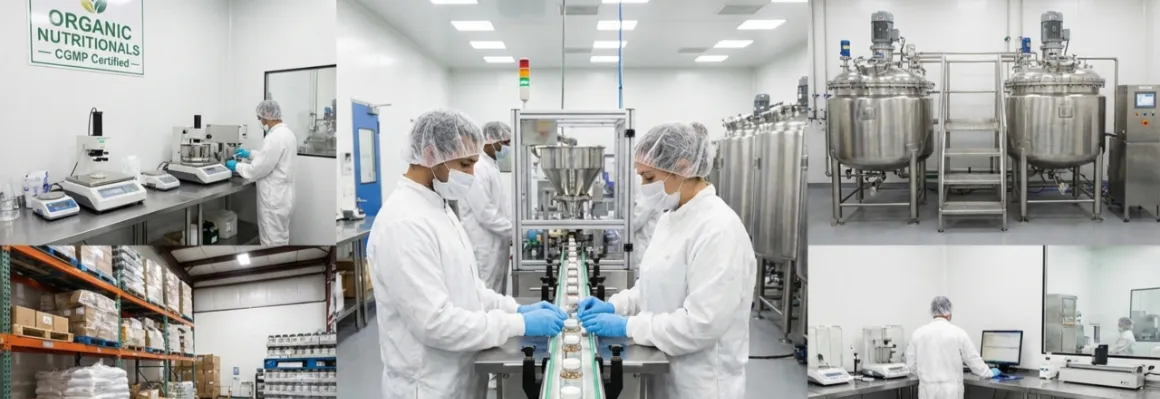
Most supplement brands never see what really happens between a product brief and a finished bottle on the shelf. Yet every hidden step—formulation, sourcing, blending, testing, packaging—directly affects safety, efficacy, and your reputation. Understanding modern health supplement manufacturing helps you:- Choose better partners
- Ask smarter questions in audits
- Spot red flags before they become recalls
- Communicate real quality stories to your customers
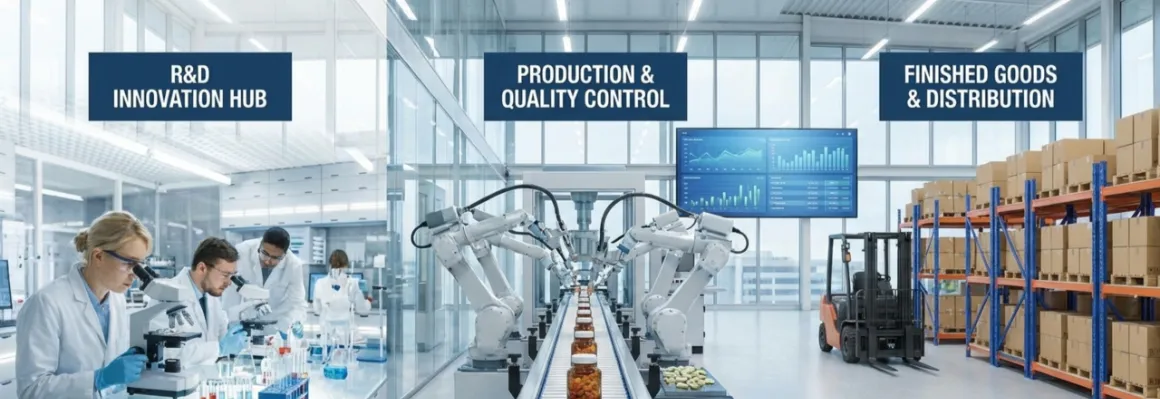
Stage 1: Market‑Driven R&D and Formulation Design
Translating Ideas Into Manufacturable Formulas
Health supplement manufacturing starts long before any powder hits a blender. A capable R&D team first translates your marketing idea into a technically realistic formula by answering questions such as:- What specific health outcome are you targeting (e.g., sleep onset, joint comfort, iron support)?
- Which ingredients have the best supporting evidence at achievable doses?
- What dosage form fits the user (capsule, tablet, gummy, stick pack, shot)?
- What regulatory limits apply in each target market?
- Efficacy – using clinically relevant doses and synergistic ingredient combinations.
- Stability – ensuring actives survive manufacturing and shelf life.
- Palatability – especially for gummies, powders, and liquids.
- Cost and scalability – designing something that can be manufactured at commercial volumes.
Selecting Functional and Support Ingredients
Beyond hero actives, every formula also requires excipients (the “inactive” components):- Flow agents and anti‑caking agents for blending and encapsulation
- Binders, disintegrants, and coatings for tablets
- Sweeteners, flavors, and acids for drink mixes or gummies
- Stabilizers and emulsifiers for liquids
- Regulatory acceptance in each market
- Allergens and dietary pattern compatibility (vegan, halal, kosher, gluten‑free)
- Clean‑label expectations and retailer requirements
Stage 2: Raw Material Sourcing and Qualification
Building an Approved Supplier Network
A modern facility does not buy raw materials from the cheapest online broker. Instead, the QA team maintains an Approved Supplier List, and each supplier is evaluated on:- GMP or food‑safety certifications
- History of compliance and audit outcomes
- Country of origin and traceability back to farm or primary processor
- Ability to provide full technical dossiers and Certificates of Analysis (COAs) for each lot
Incoming Goods Inspection and Testing
Every lot of raw material arriving at the warehouse goes through a documented receiving process:- Identity check – label verification, container integrity, and sampling.
- Quarantine – materials are held in a dedicated area until testing is complete.
- Laboratory analysis – depending on the risk profile, this can include:
- Identity confirmation (HPLC, TLC, FTIR, microscopy, DNA)
- Potency assay
- Microbiological counts (TPC, yeast/mold, pathogens)
- Heavy metals, pesticides, residual solvents
Stage 3: Pre‑Production Planning and Weighing
Master Manufacturing Records (MMRs)
For each product, the manufacturer maintains a Master Manufacturing Record describing:- Exact formula and theoretical batch size
- Equipment required at each step
- Detailed process instructions (e.g., blend speeds, times, temperatures)
- In‑process tests and sampling points
- Packaging configuration and label codes
Weighing and Dispensing
On production day, trained operators work in controlled, often segregated rooms to weigh each ingredient:- Scales are calibrated and verified before use.
- Materials are scanned or recorded by barcode to link lot numbers to the batch.
- A second person often verifies each weight to reduce error.
Stage 4: Blending, Granulation, and Pre‑Processing
Uniform Blending Is Critical
For capsules, tablets, and powders, uniform distribution of actives is essential so each serving meets label claim. Manufacturers use appropriate blending equipment (V‑blenders, ribbon blenders, high‑shear mixers) and verify:- Blend time and rotation speed
- Order of ingredient addition to minimize segregation or degradation
- In‑process blend uniformity testing—sampling from multiple points to confirm consistency
Optional Steps: Granulation and Drying
Some formulas require additional steps before dosing:- Wet or dry granulation to improve flowability and compressibility in tablets
- Fluid‑bed drying to reach safe, consistent moisture levels
- Milling or sieving to standardize particle size
Stage 5: Dosage‑Form Manufacturing
Capsule Filling
For capsules, the blend moves from the blender to a hopper on an encapsulation machine. Key controls include:- Target fill weight and acceptable tolerances
- Capsule size and shell type (gelatin, HPMC, pullulan)
- Inspection for split, dented, or under‑filled capsules
Tablet Compression and Coating
Tablet manufacturing adds complexity:- Compression – powder blend is pressed into tablets at defined hardness, thickness, and weight.
- In‑process tests – hardness, friability, disintegration time, and weight variation are checked regularly.
- Coating (if used) – protective or aesthetic coatings are applied in perforated pans or coaters, with temperature and spray controls to avoid defects (picking, mottling, roughness).
Gummies and Chewables
Health supplement manufacturing for gummies involves:- Preparing a syrup matrix (gelatin or pectin, sweeteners, water, acids)
- Cooking and cooling to precise temperatures
- Adding heat‑sensitive actives at the correct stage to protect potency
- Depositing into starch or silicone molds, then curing and coating
Powders, Stick Packs, and Sachets
For powdered products:- Blends are filled into jars, tubs, or individual stick packs on specialized filling lines.
- Fill weights and seal integrity are checked regularly.
- For effervescent or highly hygroscopic products, humidity control and specialized packaging films are critical.
Liquids and Shots
Liquid supplements or shots may use hot‑fill, cold‑fill with preservatives, or aseptic systems. The manufacturer manages:- Homogenization and emulsification (for oil‑in‑water systems)
- pH adjustment and preservative systems
- CIP/SIP sanitation for tanks and pipes
- Microbiological testing before filling and on finished units
Stage 6: In‑Process and Finished‑Product Quality Control
In‑Process Controls (IPCs)
Throughout manufacturing, QA/QC teams run IPCs to keep the batch on track:- Appearance and odor of blends or syrups
- Tablet hardness and disintegration
- Capsule and powder fill weights
- Temperature, humidity, and line clearance checks
Finished‑Product Testing
Before release, every batch undergoes a defined panel of tests, which may include:- Assay of active ingredients – to confirm label claim within acceptable ranges.
- Microbiological analysis – total plate count, yeast and mold, and specific pathogens.
- Heavy metals – lead, arsenic, cadmium, mercury, adhering to regulatory or internal limits.
- Physical tests – dissolution or disintegration, pH (for liquids), viscosity, water activity.
Stage 7: Packaging, Labeling, and Serialization
Choosing the Right Packaging
Good health supplement manufacturing aligns packaging with product needs:- Light‑sensitive actives (e.g., some probiotics, curcumin) may require amber bottles or foil blisters.
- Moisture‑sensitive formulas need desiccants, induction seals, and low water‑vapor‑transmission packaging.
- Sustainability goals influence use of recycled plastics, paper‑based solutions, or glass.
Label Application and Verification
On the packaging line:- Bottles or cartons are coded with batch/lot numbers and expiry dates.
- Labels are applied and inspected by cameras or operators for placement and correctness.
- A line clearance process ensures no remnants of previous batches remain, preventing label mix‑ups.
Stage 8: Stability Studies and Shelf‑Life Justification
Professional manufacturers do not guess expiry dates. They run stability studies under ICH‑like conditions:- Long‑term (e.g., 25 °C / 60% RH) and accelerated (e.g., 40 °C / 75% RH) storage
- Periodic testing of potency, appearance, dissolution, and micro counts
Data supports:
- Shelf‑life claims (e.g., 24 or 36 months)
- Storage instructions (“store below 25 °C”, “protect from moisture”)
- Overages in the formula to ensure actives stay at or above label claim through end of life
Stage 9: Documentation, Traceability, and Recall Readiness
The Batch Production Record (BPR)
Once the batch is complete, the BPR serves as a full history, including:- All weighed raw materials and their lot numbers
- Equipment and line used, with cleaning records
- In‑process and finished‑product test results
- Deviations and their investigations
- Final QA release signature
Complaints and Pharmacovigilance
If a consumer or retailer reports an issue—off‑odor, ineffective product, or suspected adverse reaction—the manufacturer:- Logs the complaint in a controlled system.
- Links it to relevant lot numbers and distribution.
- Investigates root causes with QA, production, and sometimes suppliers.
- Determines whether a field correction or recall is necessary.
Stage 10: Scaling From Pilot to Global Volumes
Pilot Runs for Risk Reduction
Before a global roll‑out, many brands start with small pilot batches to:- Confirm manufacturability and yield
- Test flavor, texture, and user acceptance
- Gather early stability and packaging feedback
Capacity Planning and Continuous Improvement
As volumes grow, operations teams plan:- Extra shifts or duplicate lines
- Larger blending and filling equipment
- Contracting additional raw‑material suppliers while maintaining quality standards
What This Means for Brand Owners
When you understand the reality of health supplement manufacturing, you can:- Evaluate potential partners based on systems and data, not sales promises.
- Ask for concrete evidence: MMR templates, example COAs, stability summaries, audit certificates.
- Tell authentic quality stories to consumers—explaining not just “made in a GMP facility” but how your products are formulated, tested, and monitored at every step.
Partner With Us Today
這Our modern health factory will help you to align with your brand and excel in all the areas to build trust, survive regulatory scrutiny, and scale globally.